Blank NFC Cards vs Ready-Made NFC Business Cards: Which Should You Buy?
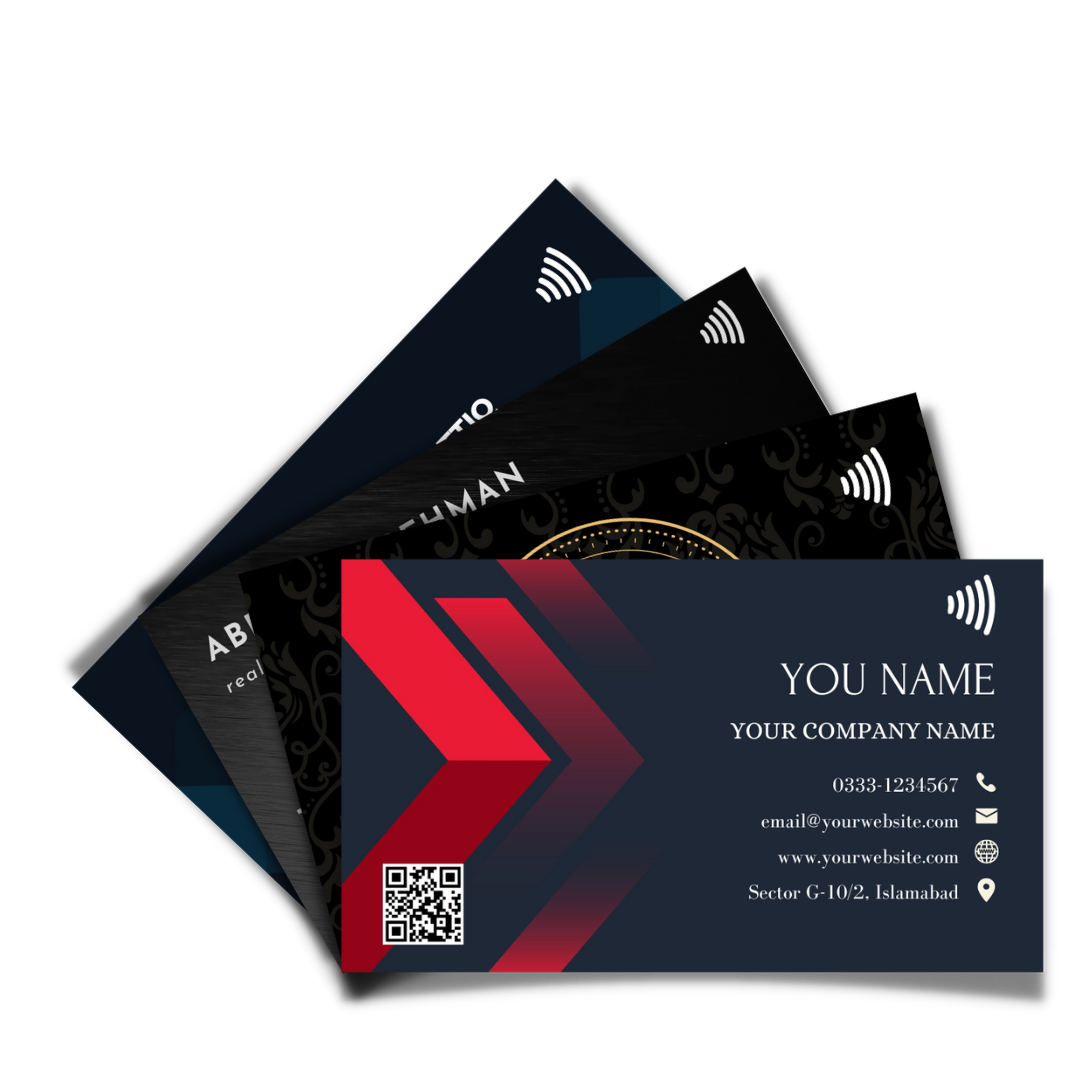
The short answer: a blank NFC card is just a chip in plastic. It is cheap, but you write a link to it yourself, and it has no design and no profile page behind it. A ready-made NFC business card is printed with your design, programmed with a profile that people can save to their contacts, and tested before you receive it. Buy blank cards to experiment. Buy a ready-made card if you will hand it to clients.
If you have searched for NFC card prices in Pakistan, you will have seen listings from around Rs 50 next to business cards costing a few thousand rupees. They are not the same product. This guide explains what you get with each, the technical details that matter, and how to avoid buying a card your customers’ phones cannot read.
What a blank NFC card is
A blank NFC card, tag or sticker contains a small chip and an antenna, usually in white PVC. Out of the box it does nothing. To use it you:
- install an NFC writing app, such as NXP’s free TagWriter app for Android and iPhone
- choose what to write: a website link, a phone number or a contact card
- hold the phone to the card to write it
- optionally lock the card so nobody can overwrite it. Locking is permanent.
That is fine for testing or for a hobby project. But a blank white card is not something you would hand to a client, and if you write your details straight onto the chip, you have to rewrite the card every time they change.
What a ready-made NFC business card includes
- A printed design with your logo and details: PVC in full colour, wood in one colour, or metal in black, gold or silver.
- A digital profile page: photo or logo, call, WhatsApp, email and save-contact buttons, website, location and social links.
- A card programmed with your profile link, so you update the profile without touching the card.
- A QR code for phones without NFC, on PVC cards and the PVC back of metal cards.
- Testing on a phone before dispatch, and help if something doesn’t open.
Our prices for complete cards are on the NFC card price list.
Side by side
| Blank NFC card or tag | Ready-made NFC business card | |
|---|---|---|
| Design | None (plain white or a generic print) | Your logo and details, mocked up for approval |
| What a tap opens | Whatever you write to it yourself | Your digital profile page |
| Updating details | Rewrite the chip, unless you link it to a page you control | Update the profile. The card stays the same. |
| QR backup | Usually none | Yes, on PVC and on the back of metal cards |
| Set-up | You install an app and write the chip | Programmed and tested for you |
| Best for | Experiments, home automation, hobby projects | Meeting clients, teams, shops and events |
Technical details worth checking before you buy
1. Make sure it is really NFC
Phones read NFC at 13.56 MHz. Some cheap “RFID cards”, often used for door access and attendance, work at 125 kHz, and phones cannot read them at all. If a listing mentions 125 kHz, EM4100 or “proximity card”, it will not work as a phone-tap business card.
2. The chip type and memory
Most business and review cards use NXP’s NTAG chips. According to NXP’s NTAG213/215/216 data sheet, the user memory is:
- 144 bytes on the NTAG213
- 504 bytes on the NTAG215
- 888 bytes on the NTAG216
A web link fits easily on any of them. The difference matters only if you try to store a full contact card on the chip itself, which is one more reason to link to a profile page instead. Our review cards and the review standee use the NTAG215. The desk plate and review coin use the NTAG213.
3. Phone compatibility
iPhone XS and newer read NFC tags in the background, without opening an app, as Apple’s Core NFC documentation describes. Many Android phones have NFC, but it can be switched off in settings. That is why a printed QR code on the card is a useful backup.
4. Metal blocks NFC
A card made entirely of metal will not tap reliably, because metal blocks the signal. Good metal NFC cards have a non-metal side for the chip. Ours are read through their PVC back.
Which should you buy?
- Buy blank NFC cards if you want to experiment, are comfortable writing chips yourself, and won’t be handing the card to clients.
- Buy a ready-made NFC business card if the card represents you or your business, you want a profile people can save, and you don’t want to write and test chips yourself.
- For review requests at a counter or reception, a programmed review card, standee, plate or coin saves you finding and writing the correct review link yourself.
Ready to design yours? See custom NFC business cards, browse all NFC business cards, or read how ordering and tapping work.
Sources
- NXP Semiconductors, NTAG213/215/216 product data sheet (memory sizes).
- Apple Developer, Adding support for background tag reading (iPhone XS and later).
- Google Play, NFC TagWriter by NXP.
